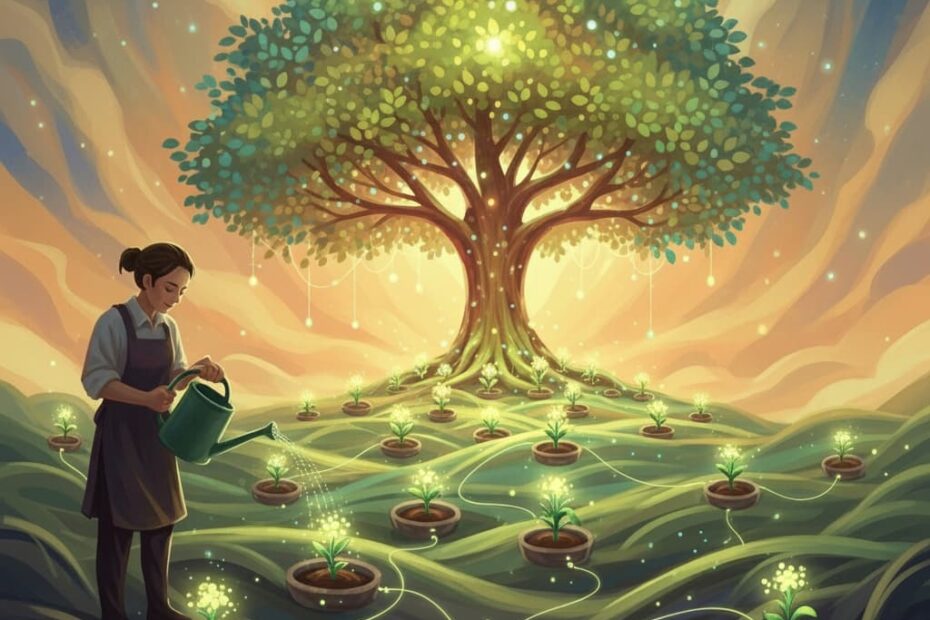
At some point in life, we all face the weight of routine as if it were an invisible prison — days that repeat, dreams that seem distant, pains that insist on remaining. But what if routine, instead of limiting us, could be the path to freedom? What if the habits we cultivate, even the simplest ones, were seeds capable of transforming not only our days but our very essence?
This article is an invitation to look at routine with new eyes: as a sacred space where healing happens, where strength is revealed, and where life reinvents itself. Here, you’ll find practices that go beyond productivity — they are daily gestures that embrace, strengthen, and awaken what is most true within you.
Science has already shown that habits shape our brains, our emotions, and even our identity. Neuroplasticity, for example, reveals that the brain is capable of reorganizing itself based on repeated experiences. In other words, changing your routine is changing your mind — and changing your mind is changing your life.
But this text is not just scientific. It’s human. It’s poetic. It’s made for those who are tired, for those who are starting over, for those who want to find themselves again. Throughout the following sections, you will be guided by deep reflections, soul-touching metaphors, and suggestions of inspiring books and films — including Asian works that carry ancestral wisdom about time, silence, and transformation.
If you’ve come this far, perhaps you’re seeking more than just tips. Perhaps you’re seeking meaning. And it’s with this purpose that we begin this journey: so that your routine ceases to be survival and becomes power. Because transforming life doesn’t require grand revolutions — it requires small habits, repeated with love.
🌅 The Awakening: When Pain Becomes the Starting Point
Pain, however cruel it may seem, is also a messenger. It shakes us, jolts us out of autopilot, and forces us to look inward. Like a storm that clears the sky, pain can be the beginning of new clarity.
According to psychiatrist Viktor Frankl, an Auschwitz survivor and author of Man’s Search for Meaning, “when we are no longer able to change a situation, we are challenged to change ourselves.” This change begins with the recognition that something needs to be different—and that is the true awakening.
📚Recommended Reading:
- The Artist’s Way, by Julia Cameron—a guide to unlocking creativity and healing emotional wounds.
- Ikigai: The Japanese Secrets to a Long and Happy Life, by Héctor García and Francesc Miralles—about purpose and longevity.
🎬Film:
- Departures (Okuribito, Japan)—a delicate work about grief, reconnection, and the value of life.
Poetic Metaphor:
“Sometimes, the ground must break for the root to find space to grow.”
🔥 The Invisible Force of Small Habits
Habits are like invisible seeds that, when cultivated with consistency, blossom into great transformations. It’s not the grand gesture that changes a life, but the small act repeated with intention.
Duke University estimates that about 40% of daily actions are habits, not conscious decisions. This means that changing your routine is, in practice, changing your life.
📚Recommended Reading:
- The Power of Habit, by Charles Duhigg—a classic on how habits work and how to transform them.
- Atomic Habits, by James Clear—about how small changes yield extraordinary results.
🎬Serie:
- Navillera (South Korea)—the story of an elderly man who decides to learn ballet at 70, showing that it’s never too late to start.
Poetic Metaphor:
“Bamboo takes years growing invisibly underground before it rises with strength. So are habits: roots before branches.”
🧠 Reprogramming the Mind: The First Step to Freedom
The mind is a garden. If we don’t choose what to plant, weeds will grow—limiting beliefs, fears, inherited patterns. Reprogramming the mind is about pulling out these roots and sowing new ideas.
Neuroplasticity, a concept studied by scientists like Norman Doidge, shows that the brain is capable of reorganizing itself throughout life. Repeated thoughts create new neural connections—meaning we can literally change the way we think.
📚Recommended Reading:
- The Brain That Changes Itself, by Norman Doidge—about neuroplasticity and healing.
- You Can Heal Your Life, by Louise Hay—about the power of thoughts on emotional health.
🎬Movie:
- Little Forest (Japan)—a young woman returns to her village and rediscovers simplicity as a form of mental healing.
Poetic Metaphor:
“The mind is like a river: it can be murky or crystal clear, depending on the banks we choose to build.”
💪 Discipline with Compassion: The Art of Persisting Without Self-Punishment
Discipline is not rigidity. It’s commitment to what matters. But when accompanied by severe self-criticism, it becomes a whip. True discipline is gentle, patient, and loving.
Psychologist Kristin Neff, a pioneer in the study of self-compassion, shows that people who treat themselves with kindness have greater resilience and lasting motivation.
📚Recommended Reading:
- Self-Compassion, by Kristin Neff—about how to be kind to yourself without losing strength.
- The Gifts of Imperfection, by Brené Brown—about vulnerability as strength.
🎬Serie:
- It’s Okay to Not Be Okay (South Korea)—addresses mental health, trauma, and the power of acceptance.
Poetic Metaphor:
“Persisting is not running in a hurry, it’s walking with tenderness even when your feet hurt.”
🕯️ Healing Silence: The Value of Introspective Moments
We live surrounded by noise. But it is in silence that the soul speaks. Meditation, conscious breathing, and solitude are practices that reconnect us with the essential.
Studies from Harvard Medical School show that meditation reduces cortisol (the stress hormone) and increases activity in brain areas linked to empathy and self-regulation.
📚Recommended Reading:
- What Is God?, by Deepak Chopra—about spirituality and inner silence.
- The Art of Living, by Thich Nhat Hanh—Buddhist teachings on presence.
🎬Movies and Series:
- Spring, Summer, Fall, Winter… and Spring (South Korea)—a contemplative work about life cycles and silence.
Poetic Metaphor:
“Silence is the space where the soul breathes.”
📖 Write Your Pain, Rewrite Your Story
Writing is an act of healing. When we put pain on paper, it stops being an invisible monster and becomes a narrative—something we can understand, reframe, and finally, release.
Therapeutic writing is studied by James Pennebaker, who showed that writing about deep emotions improves immunity and reduces symptoms of depression.
📚Recommended Reading:
- The Diary of a Young Girl, by Anne Frank—a powerful example of writing as resistance and hope.
- Letters to a Young Poet, by Rainer Maria Rilke—about the depth of personal expression.
🎬Movie
- Calligraphy of the Soul (China)—about how writing and art can heal trauma.
Poetic Metaphor:
“Every written word is a thread that stitches the soul’s tear.”
🌿 Body in Motion, Soul at Peace
The body holds emotions. Movement is a way to release them. Walking, dancing, practicing yoga, or any physical activity is more than exercise—it’s a ritual of reconnection.
According to the Mayo Clinic, regular exercise reduces symptoms of anxiety and depression, improves sleep, and boosts self-esteem.
📚Recommended Reading:
- The Body Keeps the Score, by Bessel van der Kolk—about how trauma manifests physically.
- Yoga for the Nervous, by Hermógenes—a Brazilian classic on yoga and emotional health.
🎬Serie:
- Move to Heaven (South Korea)—addresses grief and movement as a form of healing.
Poetic Metaphor:
“The body is the temple where the soul dances its liberation.”
🧘♀️ Mindful Eating: Nourishing the Body, Honoring Life
Eating is a sacred act. When done with presence, it becomes a form of self-care. Mindful eating involves listening to your body, respecting its rhythms, and choosing foods that truly nourish.
The mindful eating approach, studied by Jan Chozen Bays, shows that eating with full attention reduces compulsive eating and improves one’s relationship with their body.
📚Recommended Reading:
- Mindful Eating: A Guide to Rediscovering a Healthy and Joyful Relationship with Food, by Jan Chozen Bays.
- The Raw Food Revolution Diet, by Conceição Trucom—about natural and energetic nutrition.
🎬Movie
- Ramen Shop (Singapore/Japan)—about food as memory, affection, and family reconnection.
Poetic Metaphor:
“Every meal is a poem the body recites in silence.”
🤝 Surround Yourself with Light: Relationships That Elevate
We are made of encounters. The people we are around shape our energy, our beliefs, and even our emotional health. Cultivating nourishing relationships is essential for a powerful routine.
Harvard University studies, in the longest-running study on happiness ever conducted (Harvard Study of Adult Development), reveal that healthy relationships are the primary factor for well-being and longevity—more so than money, fame, or professional success. The quality of the bonds we maintain directly affects our physical and emotional health. This means choosing who we share our routine with is an act of self-care. Relationships that elevate are those that listen to us, inspire us, and embrace us without judgment. Sometimes, this requires courage to distance ourselves from toxic ties and make space for new connections.
📚Recommended Reading:
- The Gifts of Imperfection, by Brené Brown—about vulnerability and authenticity in relationships.
- The Immoral Soul, by Nilton Bonder—about necessary breaks for evolution.
🎬Serie:
- My Liberation Notes (South Korea)—a sensitive narrative about loneliness, connection, and the desire for emotional liberation.
Poetic Metaphor:
“Some people are like the sun: they don’t just warm the body, they illuminate the dark corners of the soul.”
🌟 Morning Ritual: Start the Day with Purpose
How we begin our day sets the tone for our decisions, emotions, and productivity. Creating a morning ritual is like lighting a candle before entering a temple—a symbolic gesture that prepares the spirit for what’s to come.
According to Hal Elrod, author of The Miracle Morning, dedicating just one hour to waking up with practices like meditation, reading, writing, and exercise can completely transform your life. The secret lies in intention: it’s not about doing a lot, but doing with presence.
📚Recommended Reading:
- The Miracle Morning, by Hal Elrod.
- Miracle Mornings for Entrepreneurs, an adapted version for those seeking productivity with purpose.
🎬Film:
- Still Walking (Japan)—a delicate work about everyday life and the small rituals that sustain family life.
Poetic Metaphor:
“Each morning is a blank page. The ritual is the pen that writes with intention.”
🕊️ Acceptance: The Most Liberating Habit of All
Acceptance is not giving up. It’s acknowledging what cannot be changed and, from there, choosing how to move forward. Acceptance is one of the most difficult—and most liberating—habits.
The psychology of acceptance, present in Acceptance and Commitment Therapy (ACT), shows that fighting negative emotions only intensifies them. Accepting them, on the other hand, allows them to pass like clouds in the sky.
📚Recommended Reading:
- Radical Acceptance: Embracing Your Life with the Heart of a Buddha, by Tara Brach—about how to embrace pain with compassion.
- The Power of Now, by Eckhart Tolle—about presence and acceptance of the present moment.
🎬Film:
- Departures (Japan)—about accepting the cycle of life and finding beauty in farewell.
Poetic Metaphor:
“Acceptance is like opening your hands: what needs to leave, leaves; what needs to stay, rests.”
🔄 Evolving is Starting Over: How to Keep the Flame Alive
Transforming your routine is a continuous process. There is no finish line, only new beginnings. Evolving is starting over—with more awareness, more lightness, and more courage.
Motivation is not constant, but rituals can sustain it. According to BJ Fogg, a researcher at Stanford University, the key to maintaining habits is to make them small, easy, and connected to positive emotions. Celebrating each step is essential.
📚Recommended Reading:
- Tiny Habits: The Small Changes That Change Everything, by BJ Fogg—about how to create sustainable habits.
- Year of Yes: How to Dance It Out, When Life is Happening, by Shonda Rhimes—about starting over with boldness.
🎬Serie:
- Start-Up (South Korea)—about entrepreneurship, new beginnings, and persistence.
- Poetic Metaphor: “The flame of transformation doesn’t go out—it just changes shape, like the sun hiding to rise again.”
🌈 Conclusion: Routine as a Path to Healing
Routine, when lived with intention, is a sanctuary. It ceases to be a prison and becomes freedom. Each habit cultivated with love is a brick in the construction of a lighter, stronger, and truer life.
This article is not a manual, but an invitation. A call for you to look at your pain with tenderness, at your days with reverence, and at yourself with courage. Transformation doesn’t happen in a day—it happens every day, in small gestures, in silent choices, in discreet new beginnings.
You don’t need to be perfect. You just need to be willing to walk. And if you stumble, that’s okay—the ground can also be a place of healing.
📚Final Reading Suggestion:
When Nietzsche Wept, by Irvin D. Yalom—about pain, philosophy, and transformation.
The Elegance of the Hedgehog, by Muriel Barbery—about hidden beauty in routine.
🎬Inspiring Asian Film:
After the Storm (Japan)—about new beginnings, family, and the value of small moments.
Last Poetic Metaphor:
“Routine is like a garden: if watered with intention, it blooms even on cloudy days.”